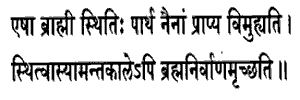
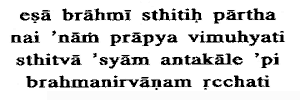
| 72. This is the
Brahmic state, O son of Pritha. Attaining to this, none is deluded. Remaining
in this state even at the last period of life, one attains to the felicity
of Brahman.This foregoing stateto renounce all and to dwell in Brahmanis
the Divine state, the state of Brahman. It pertains to and has its being
in Brahman. On reaching this state, one is no longer deluded. Remaining
in this state even at the last period of life, one attains moksha, the felicity
of Brahman. And it needs no saying that he who renounces while yet a student
and dwells in Brahman throughout life attains the Felicity of Brahman, the
BrahmaNirvana.The two aspects of wisdom relating respectively to Pravritti
and Nivritti, i.e to the Path of Works and the Path of Renunciationwith
which the GitaSastra is concerned have been pointed out by the Lord in the
Second Discourse. He has recommended renunciation of action to those who
hold to the Sankhyabuddhi (Sankhya aspect of wisdom) and has added in 72
that their end can be achieved by being devoted to that alone. And as to
Arjuna, He has declared in 47 that he should resort to works (karma) alone
as based on Yogabuddhi (the Yoga aspect of wisdom), while it hasn't been
said that the Highest Good can be attained by that alone Seeing this, Arjuna
is troubled in mind and therefore puts a question to the Lord. This perplexity
in Arjunas mind is quite explicable. He thinks, how might the Lord first
describe to me a devout seeker of Bliss the direct means of attaining Bliss,
namely adherence to the Sankhya aspect of wisdom, and then command me to
do action which is fraught with many a tangible evil and which is but an
indirect and uncertain means of attaining Bliss ? |