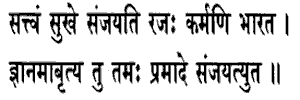
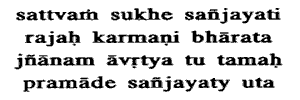
| 9. Sattva attaches
to happiness, Rajas to action, O Bharata, while Tamas, enshrouding wisdom,
attaches, on the contrary, to heedlessness. Tamas, by its very nature as
a veil, covers the judgment caused by Sattva and attaches one to heedlessness,
i e to the nonperformance of necessary duties. The mutual action of the
gunas. When do the gunas produce the effects described above? The answer
follows 10. Sattva arises, O Bharata, predominating over Rajas and Tamas
; and Rajas, over Sattva and Tamas ; so Tamas, over Sattva and Raja. When
Sattva increases predominating over both Rajas and Tamas, then, asserting
itself, Sattva produces its own effect, knowledge and happiness: Similarly,
when the guna of Rajas increases, predominating over both Sattva and Tamas,
then it gives rise to its own effect, via action such as husbandry. Similarly,
when the guna called Tamas increases, predominating over both Sattva and
Rajas, then it produces its own effects, the covering of wisdom, etc. how
to know when a particular guna is predominant. What is the characteristic
mark by which to know when a particular guna is predominant ?The answer
follows: |