| 5.Now the following
objection may be raised:A passage in the smriti, Having promised immunity
from fear to all beings, one should resort to freedom from activity (naishkarmya),shows
that actionlessness can be attained by renouncing the prescribed duties.
Our experience also favours the idea that freedom from activity can be attained
by:abstaining from action. Of what use then is the performance f action
to one who seeks for freedom from action In reply the Lord says: Nobody
can attain perfection, i.e freedom from activity, or devotion in the path
of know ledgeby mere renunciation, by merely abandoning action, without
possessing knowledge.The ignorant are swayed by Nature.For what reason,
then, does a person not attain perfection, i.e freedom from activity, by
mere renunciation unaccompanied with knowledge ?The reason thus asked for
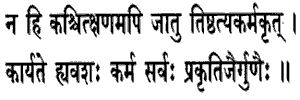
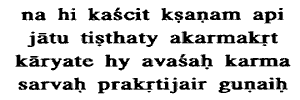
is given as follows:None, verily, even for an instant ever remains doing
no action ; for every one is driven helpless to action by the energies born
of Nature.The energies (gunas) are three, Sattva, Rajas and amas Every one
means every living being that is wise man (that he is one) who is unshaken
by the energies (xiv 23 )Since the Sankhyas have been distinguished from
the Yogins (i. 3), the Karmayoga, devotion to action, is indeed meant for
the ignorant only, not for the wise. As for the wise who are unshaken by
the gunas, and who in themselves are devoid of any change whatever, the
Karmayoga is out of place. And this was explained at length in our comments
on The unenlightened should not give up KarmaYoga Now, for him who knows
not the Self, it is not right to neglect the duty enjoined on him. So, the
Lord says: |