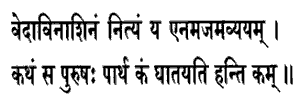
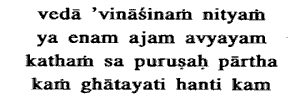
| 21. Whose knows
Him as indestructible, eternal, unborn and inexhaustible,How, O son of Pritha,
and whom does such a man cause to slay, and whom does he slay ?He who knows
the Self (described in the last verse) as indestructible, i.e devoid of
the final change called death, as eternal, i.e devoid of change called transformation,
as unborn and inexhaustible, i.e devoid of birth and decline; how does an
enlightened man of this description do the act of slaying, or how does he
cause another to slay He slays nobody at all, nor does he at all cause another
to slay.In both the places, denial is meant, since no question can have
been asked. The reason for the denial of slaying applying to all actions
alike, what the Lord means to teach in this section appears to be the denial
of all action whatsoever in the case of the enlightened ; the denial, however,
of the specific act of slaying being only meant as an example.(Objection):What
special reason for the absence of action in the case of an enlightened man
does the Lard see when denying actions in the words how does such a man
slay ?(Answer):The immutability of the Self has already been given as the
reason for the absence of all actions.Because no reply follows. Viz the
immutability of the Self.(Objection):True, it has been given ; but that
cannot be a sufficient reason, since the enlightened man is distinct from
the immutable Self. We cannot indeed say that a man who has known an immovable
pillar can have no action to do.(Answer):This objection does not apply.
For, the enlightened man is identical with the Self. Enlightenment (vidvatta)
does not pertain to the aggregate of the body, etc. Therefore, as the only
other alternative, the enlightened man should be identical with the Self,
who is not included in the aggregate and is immutable. |